

Thailand Tractor Market Research Report: Forecast (2026-2032)
By Tractor Type (Utility Tractors, Row Crop Tractors, Orchard Tractors, Garden Tractors, Compact Tractors), By Power Output (Upto 30 HP, 31–40 HP, 41–60 HP, 61–80 HP, 81–100 HP, 10 ... 1–120 HP, 121–150 HP, 151–180 HP, 181 HP and above), By Drive Type (Two-Wheel Drive (2WD), Four-Wheel Drive / All-Wheel Drive (4WD/AWD)), By Propulsion Type (Diesel, Battery-Electric, Hybrid), By Application (Agriculture, Construction, Forestry, Municipal & Grounds Maintenance, Haulage & Logistics), and others Read more
- Automotive
- Aug 2026
- Pages 145
- Report Format: PDF, Excel, PPT
Thailand Tractor Market
Projected 5.7% CAGR from 2026 to 2032
Study Period
2026-2032
Market Size (2026)
USD 2.23 Billion
Market Size (2032)
USD 3.11 Billion
Base Year
2025
Projected CAGR
5.7%
Leading Segments
By Tractor Type: Utility Tractors
Thailand Tractor Market Key Takeaways
- The Thailand tractor market size was valued at USD 2.12 billion in 2025 and is projected to grow from USD 2.23 billion in 2026 to USD 3.11 billion by 2032.
- The industry is projected to witness steady growth at a CAGR of 5.7% during 2026-2032.
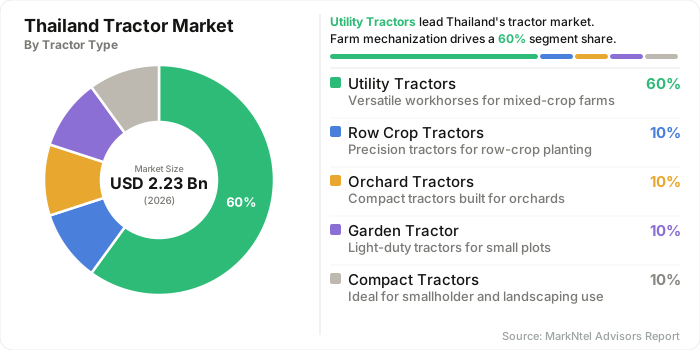
- Utility tractors are expected to dominate the market, accounting for approximately 60% of total revenue in 2026.
- Agriculture is anticipated to remain the leading application segment, capturing around 92% of the market in 2026.
- The industry remains Moderately consolidated, with the top five manufacturers collectively accounting for approximately 65% of the total market revenue in 2026.
Thailand Tractor Market Size and Outlook
The tractor market size in Thailand was valued at USD 2.12 billion in 2025 and is projected to grow from USD 2.23 billion in 2026 to USD 3.11 billion by 2032, registering a CAGR of around 5.7% during 2026-2032. Market expansion will be supported by expanding irrigated cropland, rising mechanization among small and medium farms, and increasing replacement demand for aging tractor fleets across Thailand's rice, sugarcane, and rubber-growing regions.
Growth prospects remain closely tied to the government's expanding water management infrastructure, which directly determines how much cultivable land can support multiple cropping cycles requiring tractor-based land preparation. In June 2025, Thailand's Cabinet approved an integrated water-management plan covering 55,003 projects worth USD 13.32 billion across eight ministries, 67 provinces, and 1,643 local government bodies. A larger irrigated cropland base is expected to sustain recurring tractor utilization for plowing, cultivation, and haulage throughout the forecast period.
Supporting this outlook, officials presented a proposal in June 2025 for 12 new water infrastructure projects under the Royal Initiative, carrying a combined budget of USD 450.3 million. These schemes are projected to benefit more than 563,239 households across over 134,620 rai of land, create 29,214 jobs, and increase annual water supply by 211.46 million cubic metres. Improved water reliability across these newly benefited farming regions is expected to encourage greater tractor purchases and higher machinery utilization rates. Collectively, these developments are anticipated to reinforce long-term demand and support the expansion of Thailand's tractor industry throughout the forecast period.
Thailand Tractor Market Key Indicators
- According to the Office of Agricultural Economics (OAE), Thailand maintains official statistics on rubber plantation area, tapping area, production volume, and yield, with datasets updated through the OAE data catalog in 2025. Rubber remains one of Thailand's largest commercial plantation crops, particularly in the Southern region, where tractors are increasingly used for land preparation, plantation maintenance, fertilizer application, and transportation. Growth in Thailand's rubber cultivation and production increases mechanized plantation operations, driving demand for tractors used in plantation establishment, maintenance, and material handling.
- Thailand's Royal Irrigation Department (RID) received a budget allocation of approximately USD 2.25 billion for FY2025, up from approximately USD 2.40 billion in FY2024, making it the largest agency under the Ministry of Agriculture and Cooperatives. The increased allocation is intended to expand and improve irrigation systems, water resource management, and agricultural water distribution infrastructure across the country. Expansion of irrigation infrastructure enables multiple cropping cycles, increases cultivated acreage receiving reliable water supply, and raises tractor utilization for land preparation, planting, and field operations. Greater machinery usage also shortens replacement cycles, thereby supporting sustained demand for new tractors.
- Thailand's sugar industry remains one of the country's largest agricultural industries and a major source of demand for agricultural machinery. According to the Office of the Cane and Sugar Board (OCSB), Thailand's 2025/26 sugarcane production is forecast to reach approximately 96 million metric tonnes, with attractive farm-gate returns encouraging continued sugarcane cultivation. The government also expects higher sugar output due to improved yields and favorable weather conditions. Expansion in sugarcane cultivation and harvesting increases the utilization of medium- and high-horsepower tractors for land preparation, cultivation, haulage, and field transportation, thereby directly supporting growth in Thailand's tractor market.
- The Bank for Agriculture and Agricultural Cooperatives (BAAC) remains Thailand's primary source of financing for farmers and agricultural machinery purchases. According to BAAC's FY2025 Annual Report, the bank continued expanding financial support to the agricultural sector, with total outstanding loans of approximately USD 48.4 billion as of 31 March 2025, while maintaining financial assistance across farming households, agricultural cooperatives, and agribusinesses. Greater availability of agricultural credit improves farmers' purchasing power and enables investment in new and replacement tractors, directly supporting growth in Thailand's tractor market by increasing machinery financing and accelerating mechanization.
Thailand Tractor Market Scope
| Category | Segments |
|---|---|
| By Tractor Type | Utility Tractors, Row Crop Tractors, Orchard Tractors, Garden Tractors, Compact Tractors |
| By Power Output | Upto 30 HP, 31–40 HP, 41–60 HP, 61–80 HP, 81–100 HP, 101–120 HP, 121–150 HP, 151–180 HP, 181 HP and above |
| By Drive Type | Two-Wheel Drive (2WD), Four-Wheel Drive / All-Wheel Drive (4WD/AWD |
| By Propulsion Type | Diesel, Battery-Electric, Hybrid |
| By Application | Agriculture, Construction, Forestry, Municipal & Grounds Maintenance, Haulage & Logistics |
Thailand Tractor Market Growth Drivers
Government-Led Farm Mechanization Programs Accelerating Tractor Adoption Across Thailand
Thailand's tractor market is benefiting significantly from government initiatives aimed at increasing agricultural mechanization and improving farm productivity. The Ministry of Agriculture and Cooperatives (MOAC) and the Department of Agricultural Extension (DOAE) are actively encouraging farmers to adopt mechanized farming. A major component of this strategy is the Agricultural Service Provider (ASP) program, which enables certified machinery operators to provide tractor-based services such as land preparation, seeding, and harvesting to farmers who are unable to invest in their own equipment. The program lowers the financial barrier to mechanization and expands tractor utilization across small and medium-sized farms.
Further strengthening this driver, the Department of Agricultural Extension expanded its eMachine digital platform in 2025, allowing farmers to easily locate registered Agricultural Service Providers offering tractors, combine harvesters, laser land-leveling equipment, and other mechanized farming services. The platform improves machinery accessibility, increases equipment utilization rates, and enhances operational efficiency across Thailand's agricultural sector. As the number of mechanization service providers grows, operators are required to procure additional tractors to expand their service capacity and replace aging fleets, directly stimulating tractor sales. Simultaneously, increased exposure to mechanized farming encourages many farmers to transition from hiring machinery services to purchasing tractors as their operational scale expands.
Recent Trends
Rising Adoption of Laser Land Leveling Driving Demand for Precision-Compatible Tractors in Thailand
The Thailand tractor market is experiencing increasing adoption of Laser Land Leveling (LLL) as farmers seek to improve field productivity, reduce input costs, and optimize water utilization through precision farming practices. Laser-guided land leveling requires tractors equipped with compatible hydraulic systems and sufficient horsepower to operate laser-controlled scrapers, thereby driving demand for medium- and high-horsepower tractors. According to Thailand's Department of Agricultural Extension (DOAE), Laser Land Leveling enhances irrigation efficiency, improves fertilizer distribution, minimizes waterlogging, reduces weed infestation, and creates uniformly leveled fields that support higher crop productivity. As precision agriculture gains wider acceptance, farmers are increasingly investing in tractors capable of operating advanced land preparation implements, strengthening demand for technologically advanced agricultural machinery across Thailand.
Supporting this development, the Department of Agricultural Extension (DOAE) expanded its Agricultural Service Provider (ASP) initiative during 2025 by promoting the eMachine digital platform, which enables farmers to locate certified providers offering tractor-based services, including Laser Land Leveling, precision land preparation, and other mechanized farming operations. The initiative improves access to advanced machinery without requiring significant capital investment, particularly for small and medium-sized farms. By encouraging shared utilization of modern tractors and precision equipment, the program is expected to accelerate mechanization, improve machinery utilization rates, and expand the adoption of precision-compatible tractors across Thailand, supporting the country's transition toward more efficient and sustainable agricultural production.
Thailand Tractor Market Opportunities and Challenges
Limited Tractor Ownership Encouraging Growth of Agricultural Machinery Financing and Fleet Modernization
Thailand’s tractor market faces a challenge due to limited individual ownership of agricultural machinery among small and medium-sized farmers, as high acquisition costs and seasonal equipment utilization can reduce the financial attractiveness of purchasing tractors independently. Many farmers continue to depend on machinery access through external operators, which can delay direct ownership growth and slow replacement cycles. This creates a barrier for manufacturers targeting smaller farming communities, where investment decisions are influenced by affordability, expected productivity improvements, and equipment utilization levels rather than only operational requirements.
However, limited tractor ownership is creating opportunities for machinery financing, leasing models, and fleet modernization among commercial operators and agricultural businesses. The Bank for Agriculture and Agricultural Cooperatives (BAAC) supports technology-oriented agricultural investment through financing solutions such as the Smart Tech Loan for Agricultural Machinery & Technology, helping farmers access modern equipment with reduced capital constraints. In addition, Kubota expanded its Kubota Research & Development Asia (KRDA) facility in Thailand in 2025 to accelerate development of localized agricultural machinery solutions suited to Southeast Asian farming conditions. These developments are expected to encourage replacement of older fleets and improve adoption of advanced tractors.
Segmentation Insights
Utility Tractors Hold Approximately 60% Market Share, Supported by Versatility and Multi-Application Usage
The segment’s dominance is driven by its ability to perform multiple farming operations across diverse agricultural environments, making it suitable for small, medium, and commercial farming activities. Utility tractors provide flexibility for activities such as soil preparation, plowing, cultivation, transportation, and implement operations, reducing the need for farmers to invest in multiple specialized machines. The increasing focus on improving farm productivity and optimizing equipment utilization is further supporting demand for utility tractors across Thailand’s agricultural sector.
Supporting this trend, Siam Kubota Corporation introduced its next-generation agricultural machinery solutions in Thailand through continued product development focused on improving operational efficiency and supporting diverse farming requirements. The company’s localized approach toward developing machinery suited to Thai agricultural conditions highlights manufacturers’ focus on enhancing tractor performance, attachment compatibility, and user convenience. Additionally, the growing adoption of multi-purpose tractors among agricultural service providers and commercial operators is encouraging demand for utility models capable of handling different field applications throughout the year. As farmers and machinery operators increasingly prioritize flexible equipment solutions with lower ownership complexity, utility tractors are expected to maintain their leading position in Thailand’s tractor market during the forecast period. Based on the tractor type, the market is further bifurcated into:
- Utility Tractors
- Row Crop Tractors
- Orchard Tractors
- Garden Tractors
- Compact Tractors
Agriculture Accounts for Approximately 92% Market Share, supported by Strong Crop Production and Expanding Agricultural Mechanization
Thailand's position as one of the world's leading producers and exporters of rice, cassava, sugarcane, rubber, and oil palm continues to generate substantial demand for agricultural machinery. Rising labor shortages, increasing cultivation costs, and the need to improve productivity have accelerated the adoption of tractors for land preparation, planting, cultivation, transportation, and post-harvest operations. According to Thailand's Office of the Cane and Sugar Board (OCSB) under the Ministry of Industry, the country processed more than 92 million tonnes of sugarcane during the 2024/25 crushing season, highlighting the significant mechanization requirements of Thailand's sugar industry. The increasing scale of commercial crop production continues to reinforce agriculture's dominant contribution to tractor demand across the country.
Supporting this trend, Siam Kubota Corporation signed a Memorandum of Understanding (MoU) with Thailand's Department of Skill Development (DSD) under the Ministry of Labour in May 2025 to strengthen workforce capabilities in agricultural and construction machinery. The partnership focuses on developing standardized vocational training, enhancing machinery operation skills, and improving maintenance expertise through industry-oriented certification programs. Such government-industry collaborations facilitate greater confidence in adopting advanced agricultural machinery and contribute to higher mechanization rates, thereby reinforcing agriculture's position as the largest application segment in the Thailand tractor market throughout the forecast period. Based on the applications, the market is further bifurcated into:
- Agriculture
- Construction
- Forestry
- Municipal & Grounds Maintenance
- Haulage & Logistics
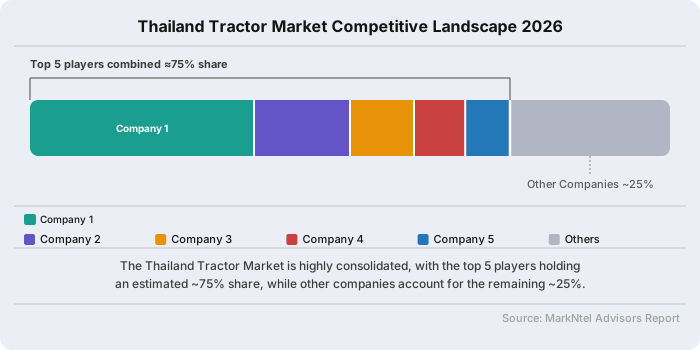
With the Top Five Competitors Accounting for Approx. 65% Market Share, the Thailand Tractor Market Remains Moderately Consolidated
The Thailand tractor market exhibits a Moderately consolidated competitive structure, with the top five companies collectively accounting for an estimated 65% of total market revenue in 2026. Siam Kubota Corporation leads the market through its strong domestic manufacturing capabilities, extensive dealer network, and broad product portfolio, followed by Yanmar S.P., New Holland Agriculture, John Deere, and Massey Ferguson. These companies benefit from established brand recognition, comprehensive after-sales service networks, and continuous investments in mechanization and precision farming technologies, creating high entry barriers for smaller domestic and international competitors.
Key Companies in the Thailand Tractor Market
- Siam Kubota Corporation Co., Ltd.
- Yanmar S.P. Co., Ltd.
- John Deere
- CNH Industrial N.V. (New Holland Agriculture)
- AGCO Corporation (Massey Ferguson)
- Mahindra & Mahindra Ltd.
- ISEKI & Co., Ltd.
- Talaythong Factory Co., Ltd.
- International Tractors Limited (Solis)
- TAFE (Tractors and Farm Equipment Limited)
- Others
Thailand Tractor Industry News and Recent Developments
May 2026: Yanmar S.P. Launches Solution Experience Center in Thailand
Yanmar S.P. Co., Ltd. officially launched the YANMAR Solution Experience Center in Bang Nam Priao District, Chachoengsao Province. Developed in collaboration with Chia Tai Company Limited and XAG Co., Ltd., the facility demonstrates tractors, agricultural machinery, drones, and integrated smart farming solutions for rice cultivation. It also serves as a training hub for farmers, students, government agencies, and agribusinesses.
Impact Analysis: The new center strengthens Thailand's agricultural mechanization ecosystem by improving farmers' access to advanced tractor technologies and precision farming practices. It is expected to increase awareness and adoption of modern tractors, supporting replacement demand and enhancing productivity across Thailand's rice-growing regions.
March 2026: Siam Kubota Launches Sugar Cane Harvesting Machines in Thailand
Siam Kubota introduced new sugar cane harvesting machines to address Thailand's agricultural labor shortages and improve harvesting efficiency. The company stated that the launch aligns with its strategy to expand mechanized solutions for commercial farming and support sustainable agricultural practices.
Impact Analysis: The launch expands Siam Kubota's agricultural machinery portfolio while creating cross-selling opportunities for tractors and farm implements. Increased mechanization of sugar cane farming is expected to drive demand for medium- and high-horsepower tractors used alongside harvesting equipment, strengthening the overall tractor market.
July 2025: Siam Kubota and SCG International Expand Agricultural Machinery Business Across ASEAN
Siam Kubota and SCG International announced an expanded collaboration to strengthen agricultural machinery distribution and after-sales support across ASEAN. The initiative builds on Siam Kubota's strong domestic manufacturing base in Thailand while enhancing regional exports of tractors, diesel engines, and agricultural equipment.
Impact Analysis: The partnership reinforces Thailand's position as a regional production hub for tractors and agricultural machinery. Higher production volumes and expanded distribution networks are expected to improve economies of scale, strengthen domestic manufacturing capabilities, and support continued investment in Thailand's tractor industry.
2026: Mahindra Farm Equipment Confirms Participation in AGRITECHNICA ASIA 2026 in Thailand
Mahindra Farm Equipment confirmed its participation in AGRITECHNICA ASIA 2026, scheduled in Thailand, where it will showcase its latest tractor portfolio and mechanization solutions for Southeast Asian agriculture. The exhibition serves as one of the region's leading platforms for introducing advanced agricultural machinery to Thai farmers and dealers.
Impact Analysis: Mahindra's participation highlights increasing competition among international tractor manufacturers in Thailand. Product demonstrations and dealer engagement at AGRITECHNICA ASIA are expected to accelerate technology adoption, strengthen distribution partnerships, and expand customer access to modern tractor solutions across the country.
Frequently Asked Questions
- Market Segmentation
- Introduction
- Product Definition
- Research Process
- Assumptions
- Executive Summary
- Thailand Tractor Production (Thousand Units) Trend 2022-2032
- Thailand Tractor Production (Thousand Units) Trend by Type of Tractor
- Utility Tractors
- Row Crop Tractors
- Orchard Tractors
- Garden Tractors
- Compact Tractors
- Company Wise Production Plants and Statistics
- Installed Production Capacity
- Actual Production
- Planned Production Target
- Thailand Tractor Production (Thousand Units) Trend by Type of Tractor
- Thailand Tractor Market Supply Chain Analysis 2022-2032
- Thailand Tractor Market Import & Export Data Analysis 2022-2032
- Thailand Tractor Market Policies, Regulations, and Product Standards
- Thailand Tractor Market Trends & Developments
- Thailand Tractor Market Dynamics
- Growth Factors
- Challenges
- Thailand Tractor Market Hotspot & Opportunities
- Thailand Tractor Market Outlook, 2020-2032
- Market Size & Outlook
- By Revenues (USD Million)
- By Units Sold (Thousand Units)
- Market Segmentation & Outlook
- By Tractor Type- Market Size & Forecast 2022-2032, USD Million
- Utility Tractors
- Row Crop Tractors
- Orchard Tractors
- Garden Tractors
- Compact Tractors
- By Power Output- Market Size & Forecast 2022-2032, USD Million
- Upto 30 HP
- 31–40 HP
- 41–60 HP
- 61–80 HP
- 81–100 HP
- 101–120 HP
- 121–150 HP
- 151–180 HP
- 181 HP and above
- By Drive Type- Market Size & Forecast 2022-2032, USD Million
- Two-Wheel Drive (2WD)
- Four-Wheel Drive / All-Wheel Drive (4WD/AWD)
- By Propulsion Type- Market Size & Forecast 2022-2032, USD Million
- Diesel
- Battery-Electric
- Hybrid
- By Application- Market Size & Forecast 2022-2032, USD Million
- Agriculture
- Construction
- Forestry
- Municipal & Grounds Maintenance
- Haulage & Logistics
- By Region- Market Size & Forecast 2022-2032, USD Million
- North
- Northeast
- Central
- South
- By Company
- Competition Characteristics
- Market Share & Analysis
- By Tractor Type- Market Size & Forecast 2022-2032, USD Million
- Market Size & Outlook
- Thailand Utility Tractors Market Outlook, 2022-2032
- Market Size & Outlook
- By Revenues (USD Million)
- By Units Sold (Thousand Units)
- Market Segmentation & Outlook
- By Drive Type- Market Size & Forecast 2022-2032, USD Million
- By Propulsion Type- Market Size & Forecast 2022-2032, USD Million
- By Application- Market Size & Forecast 2022-2032, USD Million
- By Tractor Type- Market Size & Forecast 2022-2032, USD Million
- By Region- Market Size & Forecast 2022-2032, USD Million
- Market Size & Outlook
- Thailand Row Crop Tractors Market Outlook, 2022-2032
- Market Size & Outlook
- By Revenues (USD Million)
- By Units Sold (Thousand Units)
- Market Segmentation & Outlook
- By Drive Type- Market Size & Forecast 2022-2032, USD Million
- By Propulsion Type- Market Size & Forecast 2022-2032, USD Million
- By Application- Market Size & Forecast 2022-2032, USD Million
- By Tractor Type- Market Size & Forecast 2022-2032, USD Million
- By Region- Market Size & Forecast 2022-2032, USD Million
- Market Size & Outlook
- Thailand Orchard Tractors Market Outlook, 2022-2032
- Market Size & Outlook
- By Revenues (USD Million)
- By Units Sold (Thousand Units)
- Market Segmentation & Outlook
- By Drive Type- Market Size & Forecast 2022-2032, USD Million
- By Propulsion Type- Market Size & Forecast 2022-2032, USD Million
- By Application- Market Size & Forecast 2022-2032, USD Million
- By Tractor Type- Market Size & Forecast 2022-2032, USD Million
- By Region- Market Size & Forecast 2022-2032, USD Million
- Market Size & Outlook
- Thailand Garden Tractors Market Outlook, 2022-2032
- Market Size & Outlook
- By Revenues (USD Million)
- By Units Sold (Thousand Units)
- Market Segmentation & Outlook
- By Drive Type- Market Size & Forecast 2022-2032, USD Million
- By Propulsion Type- Market Size & Forecast 2022-2032, USD Million
- By Application- Market Size & Forecast 2022-2032, USD Million
- By Tractor Type- Market Size & Forecast 2022-2032, USD Million
- By Region- Market Size & Forecast 2022-2032, USD Million
- Market Size & Outlook
- Thailand Compact Tractors Market Outlook, 2022-2032
- Market Size & Outlook
- By Revenues (USD Million)
- By Units Sold (Thousand Units)
- Market Segmentation & Outlook
- By Drive Type- Market Size & Forecast 2022-2032, USD Million
- By Propulsion Type- Market Size & Forecast 2022-2032, USD Million
- By Application- Market Size & Forecast 2022-2032, USD Million
- By Tractor Type- Market Size & Forecast 2022-2032, USD Million
- By Region- Market Size & Forecast 2022-2032, USD Million
- Market Size & Outlook
- Thailand Tractor Market Key Strategic Imperatives for Success & Growth
- Competitive Outlook
- Company Profiles
- Siam Kubota Corporation Co., Ltd.
- Business Description
- Product Portfolio
- Collaborations & Alliances
- Recent Developments
- Financial Details
- Others
- Yanmar S.P. Co., Ltd.
- Business Description
- Product Portfolio
- Collaborations & Alliances
- Recent Developments
- Financial Details
- Others
- John Deere
- Business Description
- Product Portfolio
- Collaborations & Alliances
- Recent Developments
- Financial Details
- Others
- CNH Industrial N.V. (New Holland Agriculture)
- Business Description
- Product Portfolio
- Collaborations & Alliances
- Recent Developments
- Financial Details
- Others
- AGCO Corporation (Massey Ferguson)
- Business Description
- Product Portfolio
- Collaborations & Alliances
- Recent Developments
- Financial Details
- Others
- Mahindra & Mahindra Ltd.
- Business Description
- Product Portfolio
- Collaborations & Alliances
- Recent Developments
- Financial Details
- Others
- ISEKI & Co., Ltd.
- Business Description
- Product Portfolio
- Collaborations & Alliances
- Recent Developments
- Financial Details
- Others
- Talaythong Factory Co., Ltd.
- Business Description
- Product Portfolio
- Collaborations & Alliances
- Recent Developments
- Financial Details
- Others
- International Tractors Limited (Solis)
- Business Description
- Product Portfolio
- Collaborations & Alliances
- Recent Developments
- Financial Details
- Others
- TAFE (Tractors and Farm Equipment Limited)
- Business Description
- Product Portfolio
- Collaborations & Alliances
- Recent Developments
- Financial Details
- Others
- Others
- Siam Kubota Corporation Co., Ltd.
- Company Profiles
- Disclaimer
MarkNtel Advisors follows a robust and iterative research methodology designed to ensure maximum accuracy and minimize deviation in market estimates and forecasts. Our approach combines both bottom-up and top-down techniques to effectively segment and quantify various aspects of the market. A consistent feature across all our research reports is data triangulation, which examines the market from three distinct perspectives to validate findings. Key components of our research process include:
1. Scope & Research Design At the outset, MarkNtel Advisors define the research objectives and formulate pertinent questions. This phase involves determining the type of research—qualitative or quantitative—and designing a methodology that outlines data collection methods, target demographics, and analytical tools. They also establish timelines and budgets to ensure the research aligns with client goals.
2. Sample Selection and Data Collection In this stage, the firm identifies the target audience and determines the appropriate sample size to ensure representativeness. They employ various sampling methods, such as random or stratified sampling, based on the research objectives. Data collection is carried out using tools like surveys, interviews, and observations, ensuring the gathered data is reliable and relevant.
3. Data Analysis and Validation Once data is collected, MarkNtel Advisors undertake a rigorous analysis process. This includes cleaning the data to remove inconsistencies, employing statistical software for quantitative analysis, and thematic analysis for qualitative data. Validation steps are taken to ensure the accuracy and reliability of the findings, minimizing biases and errors.

4. Data Forecast and FinalizationThe final phase involves forecasting future market trends based on the analyzed data. MarkNtel Advisors utilize predictive modeling and time series analysis to anticipate market behaviors. The insights are then compiled into comprehensive reports, featuring visual aids like charts and graphs, and include strategic recommendations to inform client decision-making
We offer flexible licensing options to cater to varying organizational needs. Choose the pricing pack that best suits your requirements:
Buy Now Inquire Before Buying
 Request Customization
 Talk to our Consultant







