

North America AI Companion Market Research Report: Forecast (2026-2032)
By Product Type (Text-based AI Companions, Voice-based AI Companions, Multi-modal AI Companions), By Application (Social Interaction & Companionship, Mental Health & Emotional Supp ... ort, Education & Learning Aid, Personal Assistance, Others), By End-User (Individual Consumers/Household, Corporate & Commercial Enterprises, Healthcare Providers, Educational Institutions, Others), and others Read more
- ICT & Electronics
- Jul 2026
- Pages 240
- Report Format: PDF, Excel, PPT
North America AI Companion Market
Projected 15.63% CAGR from 2026 to 2032
Study Period
2026-2032
Market Size (2026)
USD 10.29 Billion
Market Size (2032)
USD 24.59 Billion
Base Year
2025
Projected CAGR
15.63%
Leading Segments
By Product Type: Text-based AI Companions
North America AI Companion Market Key Takeaways
- The North America AI companion market size was valued at USD 8.12 billion in 2025 and is projected to grow from USD 10.29 billion in 2026 to USD 24.59 billion by 2032.
- The market is projected to register a CAGR of 15.63% during 2026–2032.
- Text-based AI companions hold approximately 80% of the market in 2026.
- Personal assistance represents the leading application segment in the Market, capturing approximately 37% share in 2026.
- By geography, the USA held a leading share of about 84% of the market size in 2026.
- The industry is fragmented, with the top five players collectively accounting for approximately 10% of the market share in 2026.
North America AI Companion Market Size and Outlook
The AI companion market size in North America was valued at USD 8.12 billion in 2025 and is projected to grow from USD 10.29 billion in 2026 to USD 24.59 billion by 2032. Along with this, the market is estimated to grow at a CAGR of around 15.63% during the forecast period, i.e., 2026–32.
The market is entering a new phase of development as AI companions evolve beyond conversational interfaces into persistent digital assistants supporting continuous personal and professional interactions. Advances in generative AI and deeper integration across digital ecosystems are enabling more contextual, adaptive, and reliable engagement, strengthening adoption across consumer and enterprise use cases.
Major technology companies are embedding conversational AI into productivity software, smartphones, search platforms, cloud services, and enterprise applications, expanding the reach of intelligent assistants. Microsoft has outlined a long-term vision of AI companions becoming deeply integrated into users' daily lives, while Microsoft build 2025 and Google’s ecosystem updates highlight growing momentum toward agentic AI capable of planning and executing multi-step tasks.
AI companions are also expanding beyond software, illustrated by Sony's continued development of its Aibo robotic companion, which combines autonomous behaviour, AI-driven interaction, and emotional engagement. At the same time, cross-model AI ecosystems are enabling developers to deploy multiple large language models, improving deployment flexibility and application performance.
Government initiatives are reinforcing this momentum through responsible AI adoption and stronger governance. In 2025, the U.S. General Services Administration approved major generative AI providers for federal use, encouraging wider institutional adoption. Separately, the U.S. Department of Commerce introduced initiatives in 2026 to strengthen security evaluations for frontier AI models before deployment. Together, these technological and policy developments are creating a more predictable commercialization environment for trusted AI companions across North America.
North America AI Companion Market Key Indicators
- Approximately 18% of U.S. businesses had adopted artificial intelligence by the end of 2025, according to the Federal Reserve. Rising enterprise AI adoption is expanding demand for AI companions across customer service, workflow automation, and employee productivity applications
- More than 230,000 organizations, including 90% of Fortune 500 companies, had built AI agents using Microsoft Copilot Studio in 2025. This demonstrates accelerating enterprise deployment of AI assistants and expanding commercial opportunities for AI companion platforms.
- The OECD reported that 86% of member governments used AI in public sector operations during 2025. Expanding institutional AI adoption reinforces confidence in AI technologies while supporting broader commercialization of trusted AI companion solutions.
- OpenAI's ChatGPT reached approximately 800 million weekly active users in 2025. Expanding user engagement highlights the growing mainstream acceptance of conversational AI and supports future adoption of AI companion experiences.
- AI companion applications surpassed 220 million cumulative downloads globally by July 2025, while downloads increased 88% year over year during the first half of 2025. Strong download momentum reflects accelerating consumer adoption of companion AI services.
- Character.AI reached approximately 20 million monthly active users worldwide during 2025. Rapid user growth demonstrates increasing consumer acceptance of conversational AI companions and supports continued investment across the sector
| Category | Segments |
|---|---|
| By Product Type | Text-based AI Companions, Voice-based AI Companions, Multi-modal AI Companions |
| By Application | Social Interaction & Companionship, Mental Health & Emotional Support, Education & Learning Aid, Personal Assistance, Others |
| By End-User | Individual Consumers/Household, Corporate & Commercial Enterprises, Healthcare Providers, Educational Institutions, Others |
North America AI Companion Market Growth Drivers
Rapid Foundation Model Innovation is Strengthening the Capabilities of AI Companion Platforms
Rapid advances in generative AI and large language models are significantly enhancing the intelligence, reasoning capabilities, and operational efficiency of AI companion platforms, making them increasingly capable of supporting complex and context-aware interactions. Continuous innovation among leading AI developers has accelerated improvements in language comprehension, logical reasoning, coding proficiency, and long-context processing, enabling AI companions to deliver more reliable and sophisticated conversational experiences while expanding their commercial applicability across consumer and enterprise environments.
In 2025, OpenAI introduced GPT-5.2 with enhanced reasoning, coding, and long-context capabilities, while Google's Gemini 3 intensified competition among major AI developers, accelerating the pace of foundation model innovation. During Microsoft Build 2025, Microsoft expanded Azure AI Foundry to support models from multiple providers, including xAI, Meta, and Mistral, providing developers with broader access to advanced foundation models and greater flexibility to build increasingly capable AI companion applications.
Supporting this momentum, OpenAI diversified its compute capacity in 2025 by adding Google Cloud as a cloud supplier alongside its existing infrastructure partners, reflecting the industry's growing focus on scalable AI infrastructure to support frontier models. Continued investment in cloud computing resources and advanced AI hardware is enabling developers to deploy more powerful and reliable AI companion solutions at scale. Collectively, these developments are strengthening platform performance, accelerating innovation, and supporting wider commercial adoption across the AI companion market in North America.
North America AI Companion Market Survey Insights
AI Companion Adoption and Engagement
- Roughly a quarter of U.S. adults (24%) use AI chatbots daily, including 12% several times a day and 4% almost constantly, out of the 49% of U.S. adults who use chatbots at all.
- 10% of U.S. adults report having an ongoing personal friendship with an AI chatbot, rising to 18% among adults under 30.
- 13% of Americans have shared a personal problem or secret with an AI chatbot, increasing to 23% among consumers under 30.
- One-in-ten U.S. adults (10%) say they use chatbots specifically for emotional support or advice, and 4% say they use them for companionship.
Consumer Trust and Safety Expectations
- 82% of frequent AI users (three or more times weekly) report trusting AI at least somewhat, compared with 69% of all AI users.
- Accuracy (59%) and privacy (49%) are the two leading concerns among AI users overall, with accuracy concern rising to 63% among frequent users.
- 71% of U.S. adults believe increased AI use will make their personal information less secure, versus just 3% who expect it to become more secure.
Consumer Spending and Future
- Only 8% of U.S. AI users hold an individual paid AI subscription, a share that roughly doubles to 16% among frequent users, indicating a small but expanding premium base rather than the 40% figure previously cited.
- Adoption is following a clear age gradient: 66% of adults 18 to 29 and 61% of those 30 to 49 have used a chatbot, against 42% of those 50 to 64 and 23% of those 65 and older, pointing to a widening base of habitual younger users.
- Growing use of chatbots for search (42%), work tasks among the employed (38%), and creative or entertainment purposes (24 to 25%) suggests AI companions building on this base have room to expand from conversational novelty into everyday personal and professional routines.
North America AI Companion Market Challenges and Opportunities
Strengthening Trust through Responsible AI Governance is Transforming Regulatory Challenges into Long-Term Growth Opportunities
Growing concerns surrounding trust, safety, and emotional manipulation are emerging as key challenges for the industry as these platforms become increasingly embedded in users' daily lives. The emotionally engaging nature of AI companions has intensified scrutiny over child safety, emotional dependency, data privacy, and monetization practices. Reflecting these concerns, the U.S. Federal Trade Commission launched investigations into major AI chatbot developers in 2025 to evaluate potential consumer protection risks associated with companion AI applications, signalling a more rigorous regulatory environment for market participants.
Regulatory oversight has continued to strengthen through the introduction of the first U.S. laws specifically governing AI companions. New York and California established requirements for user disclosures, suicide intervention mechanisms, and enhanced protections for minors, while California also introduced private rights of action for violations, increasing legal accountability for developers of emotionally interactive AI systems. These developments are raising compliance expectations and increasing operational complexity for companies operating in the region.
At the same time, the evolving regulatory landscape is creating significant opportunities for developers that prioritize responsible AI design and transparent governance. Safety by design, including clear disclosures, age verification, crisis detection, and responsible AI practices, is emerging as a key competitive differentiator capable of strengthening both consumer confidence and regulatory acceptance. In 2025, New York and California became the first U.S. states to introduce AI companion specific legislation, establishing governance benchmarks that are expected to influence future product development and commercialization across North America.
The introduction of mandatory suicide intervention mechanisms and enhanced protections for minors is also encouraging the development of clinically informed AI companions through integration with validated mental health frameworks and healthcare partnerships. At the same time, expanding regulatory requirements are accelerating demand for AI auditing, governance software, safety testing, and compliance services, creating new commercial opportunities while enabling developers to bring trusted AI companion platforms to market more effectively.
Segmentation Insights
Text-based AI Companions Maintaining Leadership Through Broad Accessibility and High Consumer Adoption
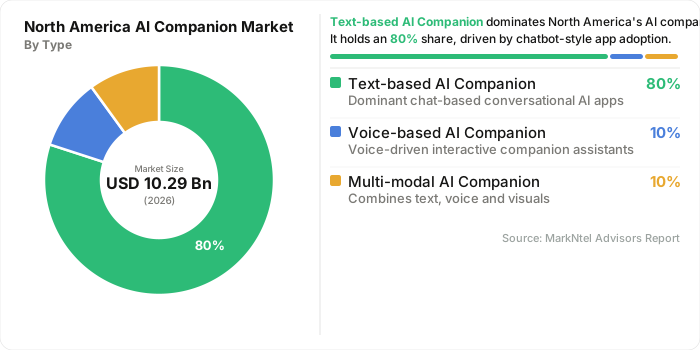
Text-based AI Companions hold approximately 80% of the North America AI companion industry in 2026, supported by their widespread availability across smartphones, personal computers, and web-based platforms. Their low computational requirements, intuitive conversational interfaces, and cost-effective deployment have encouraged adoption among individual consumers and enterprises for everyday communication, information retrieval, creative assistance, and productivity. Continuous improvements in large language models, contextual memory, and personalization capabilities are further enhancing user engagement and expanding commercial adoption across the region.
The segment also benefits from seamless integration with messaging applications, productivity software, search platforms, and enterprise workflows, allowing users to access AI companions without specialized hardware or advanced infrastructure. Subscription-based business models, frequent software updates, and expanding multilingual capabilities continue to strengthen customer retention and recurring revenues. Based on product type, the market is further bifurcated into:
- Text-based AI Companions
- Voice-based AI Companions
- Multi-modal AI Companions
Personal Assistance Driving Application Leadership Through Enterprise Integration and Everyday Utility
Personal Assistance represents the leading application segment in the North America AI companion market, capturing approximately 37% share in 2026. Its dominance is supported by growing demand for AI powered assistance across scheduling, document creation, communication, research, coding, and workflow automation. Organizations and consumers increasingly rely on AI companions to improve operational efficiency, reduce repetitive tasks, and enhance decision making across both professional and personal environments.
Rapid integration of AI companions into workplace software, cloud productivity platforms, smartphones, and digital ecosystems has significantly expanded their practical value beyond conversational interactions. Continuous improvements in reasoning, contextual understanding, and autonomous task execution allow AI companions to manage multi step activities with greater accuracy and reliability. Based on application, the market is further bifurcated into:
- Social Interaction & Companionship
- Mental Health & Emotional Support
- Education & Learning Aid
- Personal Assistance
North America AI Companion Market Geographical Outlook
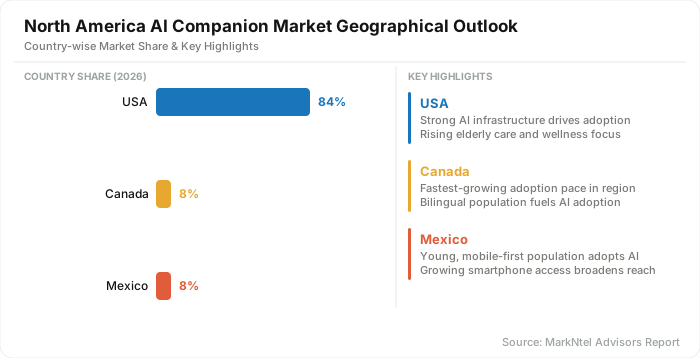
The United States dominates the market, accounting for approximately 84% of the regional market in 2026. The country's leadership is supported by the presence of major AI developers including OpenAI, Microsoft, Meta, Amazon, Character.AI, and Inflection AI, alongside its advanced cloud infrastructure and mature digital ecosystem. Strong enterprise AI investments, widespread consumer adoption, and continuous deployment of foundation models have accelerated commercialization across productivity, personal assistance, education, and enterprise applications, reinforcing the country's leadership within the regional market.
The market is further strengthened by continuous product innovation and ecosystem expansion from leading technology companies. In April 2025, Microsoft introduced the next generation of Copilot as a personalized AI companion featuring Memory, Actions, Copilot Vision, Deep Research, and cross platform capabilities, significantly expanding the practical utility of AI companions for both consumers and enterprises. During Microsoft Build 2025, the company also announced that organizations already uses Copilot Studio to build AI agents, highlighting the strong commercial momentum supporting AI companion adoption across the United States.
North America AI Companion Market Competitive Analysis
The North America AI companion market is fragmented, with competition characterized by a mix of global technology companies, specialized AI companion developers, and robotic AI solution providers. Leading participants compete through continuous foundation model innovation, multimodal AI capabilities, cloud ecosystem integration, and subscription-based monetization strategies.
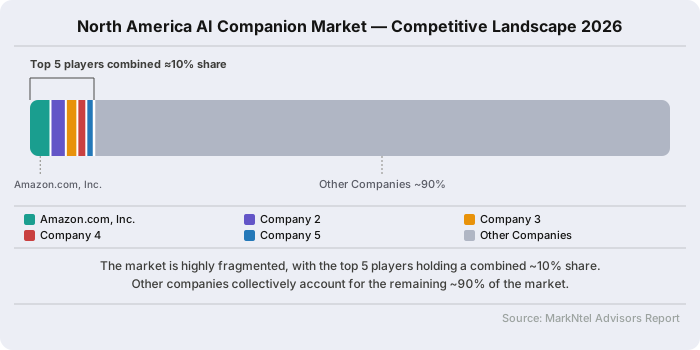
Major players including Amazon.com, Inc. (Alexa), Meta Platforms, Inc. (Meta AI), OpenAI, LLC (ChatGPT), Sony Group Corporation (Aibo), and Character Technologies, Inc. (Character.ai) collectively shape the competitive landscape, while emerging developers continue introducing specialized AI companions for productivity, emotional support, gaming, and elder care applications. The top five players collectively account for approximately 10% of the North America AI companion market.
Key Companies in the North America AI Companion Market
- Amazon.com, Inc. (Alexa)
- Meta Platforms, Inc. (Meta AI)
- OpenAI, LLC (ChatGPT)
- Sony Group Corporation (Aibo)
- Inflection AI, Inc. (Pi)
- Character Technologies, Inc. (Character.ai)
- Theai, Inc. (Inworld AI)
- Chai Research Inc. (Chai App)
- Intuition Robotics Ltd. (ElliQ)
- Luka, Inc. (Replika)
North America AI Companion Industry News and Recent Developments
April 2025: Meta Expands Meta AI as a Standalone Consumer AI Assistant
Meta Platforms launched the standalone Meta AI application in April 2025, extending its AI assistant beyond Facebook, Instagram, WhatsApp, and Messenger into a dedicated consumer platform. Powered by the Llama 4 family of models, the application introduced personalized conversations, voice interaction, and cross-device continuity, enabling Meta to compete more directly in the rapidly expanding AI companion ecosystem. The launch reflects the industry's shift toward persistent, personalized AI assistants embedded across users' daily digital experiences.
Impact Analysis: The launch intensifies competition by expanding AI companion accessibility through Meta's massive consumer ecosystem rather than relying solely on standalone chatbot adoption. Deep integration across social media, messaging, and voice interfaces increases user engagement while strengthening recurring interactions that are fundamental to AI companion platforms. The strategy is expected to accelerate consumer adoption of multimodal AI companions and encourage competing developers to enhance personalization, memory, and ecosystem integration to maintain market competitiveness.
February 2025: Amazon Launches Alexa+ With Generative AI
Amazon introduced Alexa+ in February 2025, transforming Alexa into a generative AI powered assistant capable of natural conversations, contextual memory, proactive assistance, and multi-step task execution. The upgraded assistant integrates with thousands of external services and smart home devices while supporting more personalized interactions across Amazon's ecosystem. Alexa+ represents Amazon's largest AI upgrade for its voice assistant and significantly expands the role of conversational AI within connected homes.
Impact Analysis: Alexa+ strengthens the convergence between traditional voice assistants and AI companions by introducing more persistent, context aware interactions across everyday consumer activities. The launch increases competitive pressure on AI companion providers to deliver richer multimodal experiences beyond text conversations while reinforcing demand for subscription based AI services. Broader deployment across millions of Alexa enabled devices is also expected to accelerate mainstream consumer familiarity with AI companion technologies.
Frequently Asked Questions
- Market Segmentation
- Introduction
- Product Definition
- Research Process
- Assumptions
- Executive Summary
- North America AI Companion Market Policies, Regulations, and Product Standards
- North America AI Companion Market Trends & Developments
- North America AI Companion Market Dynamics
- Growth Factors
- Challenges
- North America AI Companion Market Hotspot & Opportunities
- North America AI Companion Market Outlook, 2022-2032
- Market Size & Outlook
- By Revenues (USD Million)
- Market Segmentation & Outlook
- By Product Type- Market Size & Forecast 2022-2032, USD Million
- Text-based AI Companions
- Voice-based AI Companions
- Multi-modal AI Companions
- By Application- Market Size & Forecast 2022-2032, USD Million
- Social Interaction & Companionship
- Mental Health & Emotional Support
- Education & Learning Aid
- Personal Assistance
- Others
- By End-User- Market Size & Forecast 2022-2032, USD Million
- Individual Consumers/Household
- Corporate & Commercial Enterprises
- Healthcare Providers
- Educational Institutions
- Others
- By Region- Market Size & Forecast 2022-2032, USD Million
- United States
- Canada
- Mexico
- By Company
- Competition Characteristics
- Market Share & Analysis
- By Product Type- Market Size & Forecast 2022-2032, USD Million
- Market Size & Outlook
- US AI Companion Market Outlook, 2022-2032
- Market Size & Outlook
- By Revenues (USD Million)
- Market Segmentation & Outlook
- By Application- Market Size & Forecast 2022-2032, USD Million
- By Distribution Channel- Market Size & Forecast 2022-2032, USD Million
- By End-User- Market Size & Forecast 2022-2032, USD Million
- By Region- Market Size & Forecast 2022-2032, USD Million
- Market Size & Outlook
- Mexico AI Companion Market Outlook, 2022-2032
- Market Size & Outlook
- By Revenues (USD Million)
- Market Segmentation & Outlook
- By Application- Market Size & Forecast 2022-2032, USD Million
- By Distribution Channel- Market Size & Forecast 2022-2032, USD Million
- By End-User- Market Size & Forecast 2022-2032, USD Million
- By Region- Market Size & Forecast 2022-2032, USD Million
- Market Size & Outlook
- Canada AI Companion Market Outlook, 2022-2032
- Market Size & Outlook
- By Revenues (USD Million)
- Market Segmentation & Outlook
- By Application- Market Size & Forecast 2022-2032, USD Million
- By Distribution Channel- Market Size & Forecast 2022-2032, USD Million
- By End-User- Market Size & Forecast 2022-2032, USD Million
- By Region- Market Size & Forecast 2022-2032, USD Million
- Market Size & Outlook
- North America AI Companion Market Key Strategic Imperatives for Success & Growth
- Competitive Outlook
- Company Profiles
- Amazon.com, Inc. (Alexa)
- Business Description
- Product Portfolio
- Collaborations & Alliances
- Recent Developments
- Financial Details
- Others
- Meta Platforms, Inc. (Meta AI)
- Business Description
- Product Portfolio
- Collaborations & Alliances
- Recent Developments
- Financial Details
- Others
- OpenAI, LLC (ChatGPT)
- Business Description
- Product Portfolio
- Collaborations & Alliances
- Recent Developments
- Financial Details
- Others
- Sony Group Corporation (Aibo)
- Business Description
- Product Portfolio
- Collaborations & Alliances
- Recent Developments
- Financial Details
- Others
- Inflection AI, Inc. (Pi)
- Business Description
- Product Portfolio
- Collaborations & Alliances
- Recent Developments
- Financial Details
- Others
- Character Technologies, Inc. (Character.ai)
- Business Description
- Product Portfolio
- Collaborations & Alliances
- Recent Developments
- Financial Details
- Others
- Theai, Inc. (Inworld AI)
- Business Description
- Product Portfolio
- Collaborations & Alliances
- Recent Developments
- Financial Details
- Others
- Chai Research Inc. (Chai App)
- Business Description
- Product Portfolio
- Collaborations & Alliances
- Recent Developments
- Financial Details
- Others
- Intuition Robotics Ltd. (ElliQ)
- Business Description
- Product Portfolio
- Collaborations & Alliances
- Recent Developments
- Financial Details
- Others
- Luka, Inc. (Replika)
- Business Description
- Product Portfolio
- Collaborations & Alliances
- Recent Developments
- Financial Details
- Others
- Amazon.com, Inc. (Alexa)
- Company Profiles
- Disclaimer
MarkNtel Advisors follows a robust and iterative research methodology designed to ensure maximum accuracy and minimize deviation in market estimates and forecasts. Our approach combines both bottom-up and top-down techniques to effectively segment and quantify various aspects of the market. A consistent feature across all our research reports is data triangulation, which examines the market from three distinct perspectives to validate findings. Key components of our research process include:
1. Scope & Research Design At the outset, MarkNtel Advisors define the research objectives and formulate pertinent questions. This phase involves determining the type of research—qualitative or quantitative—and designing a methodology that outlines data collection methods, target demographics, and analytical tools. They also establish timelines and budgets to ensure the research aligns with client goals.
2. Sample Selection and Data Collection In this stage, the firm identifies the target audience and determines the appropriate sample size to ensure representativeness. They employ various sampling methods, such as random or stratified sampling, based on the research objectives. Data collection is carried out using tools like surveys, interviews, and observations, ensuring the gathered data is reliable and relevant.
3. Data Analysis and Validation Once data is collected, MarkNtel Advisors undertake a rigorous analysis process. This includes cleaning the data to remove inconsistencies, employing statistical software for quantitative analysis, and thematic analysis for qualitative data. Validation steps are taken to ensure the accuracy and reliability of the findings, minimizing biases and errors.

4. Data Forecast and FinalizationThe final phase involves forecasting future market trends based on the analyzed data. MarkNtel Advisors utilize predictive modeling and time series analysis to anticipate market behaviors. The insights are then compiled into comprehensive reports, featuring visual aids like charts and graphs, and include strategic recommendations to inform client decision-making
We offer flexible licensing options to cater to varying organizational needs. Choose the pricing pack that best suits your requirements:
Buy Now Inquire Before Buying
 Request Customization
 Talk to our Consultant







