U.S. Compact Track Loader Market Research Report Forecast: (2026-2032)
By Power Output (Low Power (<50 HP), Medium Power (50-100 HP), High Power (>100 HP)), By Lift Orientation (Vertical, Radial), By Operating Capacity (Low Capacity (Up to 1,000 lbs), ... Medium Capacity (1,000 lbs to 2,500 lbs), High Capacity (2,500 lbs to 4,000 lbs), Very High Capacity (Over 4,000 lbs)), By Fuel Type (Diesel, Gasoline, Electric, Hybrid), By Application (Construction Equipment, Agricultural Equipment, Marine Engines, Gensets, Industrial Trucks, Sports, Others), and others Read more
- Buildings, Construction, Metals & Mining
- Jun 2026
- Pages 140
- Report Format: PDF, Excel, PPT
U.S. Compact Track Loader Market
Projected 6.93% CAGR from 2026 to 2032
Study Period
2026-2032
Market Size (2026)
USD 4.10 Billion
Market Size (2032)
USD 6.13 Billion
Base Year
2025
Projected CAGR
6.93%
Leading Segments
By Power Output: Low Power (<50 HP)
The U.S. Compact Track Loader Market Key Takeaways
- The U.S. Compact track loader market is valued at USD 3.5 billion in 2025 and is projected to reach USD 4.10 billion by 2026 to USD 6.13 billion by 2032, expanding at a 6.93% CAGR during 2026-2032.
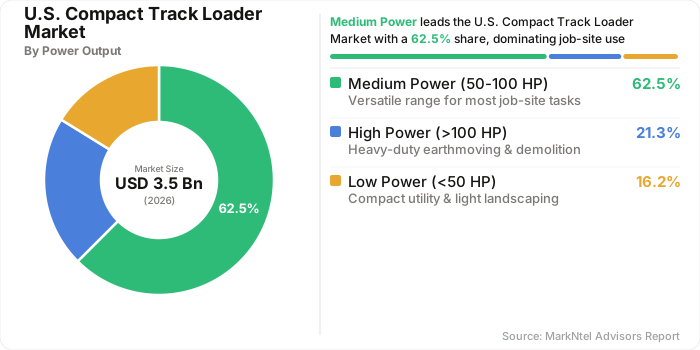
- Medium power (50-100 HP) loaders lead the market with a 62.5% share because they offer an optimal balance of transportability and lifting force.
- Vertical lift configurations remain the largest linkage segment, supported by the demand for high-clearance material placement in urban construction and the country’s high infrastructure development intensity.
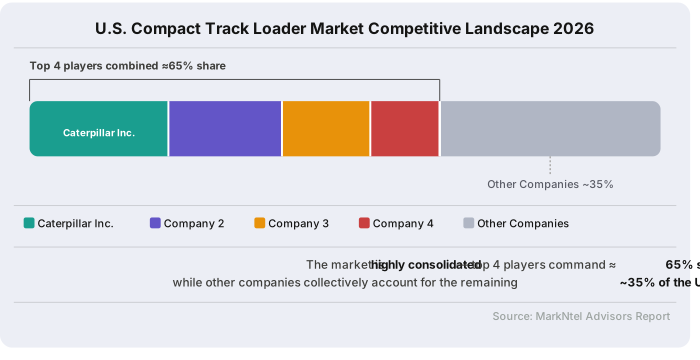
- The market is highly consolidated, with major legacy equipment producers dominating the landscape. Competition remains heavily concentrated at the top, with the leading five players together accounting for nearly 65% of the total market share.
The U.S. Compact Track Loader Market Size and Outlook
The U.S. Compact Track Loader market is estimated to grow at a CAGR of around 6.93% during the forecast period, i.e., 2026-32.
The market is demonstrating steady growth as contractors increasingly prioritize equipment versatility, productivity, and operational efficiency across a wide range of end-use applications. Beyond traditional construction activities, compact track loaders are gaining traction in landscaping, forestry, utility maintenance, and land development projects due to their ability to operate on challenging terrain while supporting multiple attachments. Their capability to perform grading, material handling, land clearing, brush management, and site preparation with a single machine platform is improving fleet utilization and strengthening their value proposition among contractors and rental operators.
According to CNH, the global construction equipment industry volume increased by 5% year-over-year for heavy equipment during Q4 2025, reflecting continued equipment investment despite a moderating macroeconomic environment. Another key factor shaping the demand Compact track loader market outlook is the gradual integration of electrification and low-emission construction equipment supported by federal environmental policy frameworks. The U.S. Environmental Protection Agency (EPA) Tier 4 emission regulations continue to push OEMs toward cleaner and alternative powertrain technologies across construction machinery.
In 2025, Deere & Company showcased its next-generation electrified and autonomous construction equipment lineup, including the 850 X-Tier electric-drive dozer with E-Drive transmission, highlighting progress toward electric-drive and hybrid solutions aimed at improving fuel efficiency and reducing emissions in heavy-duty applications.
These developments reflect the broader industry shift toward low-emission, digitally enabled construction machinery in the U.S. market, driven by tightening environmental regulations and sustainability objectives. As a result, the market is projected to grow from USD 4.10 billion in 2026 to USD 6.13 billion by 2032, supported by increasing adoption of advanced equipment technologies and continued investments in sustainable construction practices.
The U.S. Compact Track Loader Market Key Indicators
- According to the U.S. Census Bureau, total U.S. construction spending reached approximately USD 2.15 trillion in 2025, supported by continued investments in residential, commercial, manufacturing, and infrastructure projects. The expanding construction pipeline directly supports demand for compact track loaders, which are widely used for excavation, grading, material handling, and site preparation activities.
- According to the U.S. Department of Transportation and federal infrastructure funding disclosures, the Infrastructure Investment and Jobs Act (IIJA) allocates approximately USD 1.2 trillion toward national infrastructure development, including USD 550 billion in new federal investments across roads, bridges, transit, and utility projects, thereby strengthening long-term demand for high-utilization construction equipment such as compact track loaders in the U.S. market.
- According to OEM service recommendations and heavy machinery maintenance guidelines, standard rubber track replacements occur on average every 1,200 to 1,500 operational hours across national contractor fleets. However, in real-world conditions this interval often shortens due to urban driving patterns on abrasive surfaces like broken concrete or demolition debris, which leads to faster wear and in turn supports consistent, repeat demand in the aftermarket for undercarriage components.
- According to the U.S. Census Bureau, construction machinery manufacturing shipments exceeded USD 49 billion in 2025, reflecting sustained domestic production activity and a strong supply base for compact construction equipment manufacturers operating across the United States.
The U.S. Compact Track Loader Market Scope
| Category | Segments |
|---|---|
| By Power Output | Low Power (<50 HP), Medium Power (50-100 HP), High Power (>100 HP |
| By Lift Orientation | Vertical, Radial |
| By Operating Capacity | Low Capacity (Up to 1,000 lbs), Medium Capacity (1,000 lbs to 2,500 lbs), High Capacity (2,500 lbs to 4,000 lbs), Very High Capacity (Over 4,000 lbs |
| By Fuel Type | Diesel, Gasoline, Electric, Hybrid |
| By Application | Construction Equipment, Agricultural Equipment, Marine Engines, Gensets, Industrial Trucks, Sports, Others |
The U.S. Compact Track Loader Market Growth Drivers
Rising Construction Demand in Urban Development Projects
The U.S. expanding urban population continues strengthening long-term demand for compact track loaders across all construction channels. Growth in residential and commercial infrastructure is directly increasing machinery consumption as developers execute complex zoning upgrades within exceptionally confined geographic spaces. According to the U.S. Census Bureau, private residential construction spending regularly surpasses USD 800 billion annually, showcasing massive underlying demand for capable site preparation tools. The rising share of multi-family dwellings is particularly important because these projects typically require agile earthmoving machinery to navigate narrow alleys where traditional excavators cannot physically operate.
The industry is also benefiting from rising commercial real estate developments where rapid project turnarounds are prioritized to mitigate rising land acquisition expenses. Increasing dependence on versatile machinery continues supporting robust fleet procurement, particularly for loaders whose ground-engaging attachments instantly boost daily material movement metrics. This expanding project pipeline, combined with higher machine utilization and longer operational shifts, continues reinforcing stable growth opportunities for the U.S. Compact track loader sector.
Recent Trends
Customizable Attachments Expand CTL Utility Across Industrial Sectors
Contractors and fleet managers in the U.S. are increasingly adopting advanced quick-coupler systems that deliver better operational efficiency and seamless modularity. This shift is largely driven by the rising need to transition away from single-purpose heavy machines toward adaptable base platforms capable of executing diverse industrial tasks. As a result, demand is growing for versatile attachments such as industrial grapples, trenchers, and hydraulic breakers, which offer improved workflow transitions and consistent performance across changing seasonal conditions. This trend is particularly strong in highway maintenance and municipal landscaping, where operators effortlessly penetrate niche sectors.
The adoption of intelligent electro-hydraulic control systems by leading equipment manufacturers is further strengthening the need for these advanced attachments. The digital handshake between machine and tool automatically adjusts hydraulic flow parameters, making automated recognition essential across both general construction and specialized utility segments. Overall, the market is steadily transitioning from solitary earthmoving units to complete mechanized workforces, and this shift is expected to continue as jobsite requirements become increasingly dynamic.
The U.S. Compact Track Loader Market Opportunities and Challenges
Purchasing and Maintenance Prices Complexities Accelerating Demand for Rental Services
The U.S. Compact Track Loader market faces cost-related challenges due to higher purchase prices and maintenance requirements compared to skid steer loaders. Compact track loaders generally command around 35% higher acquisition costs, while operating expenses are also elevated, averaging approximately USD 4 per hour versus USD 1–2 per hour for skid steers, primarily driven by undercarriage wear and frequent maintenance needs. According to the U.S. Bureau of Labour Statistics, machinery repair and maintenance costs have shown a steady long-term increase, contributing to the rising total cost of ownership for contractors and fleet operators.
These cost pressures are accelerating a structural shift toward equipment rental models, particularly in North America, where rental adoption is widely established across construction and infrastructure sectors. Rental-based access reduces upfront capital investment, eliminates long-term maintenance burdens, and provides flexibility for project-based demand cycles. Compact track loaders are among the most frequently deployed machines in rental fleets due to their multi-application capability across earthmoving, landscaping, and utility construction. Major rental operators continue to expand compact equipment availability, reinforcing rental channels as a key driver of market accessibility and sustained demand.
Market Segmentation
Medium Power (50-100 HP) Holds the Largest Power Output Market Share
Medium Power models dominate the U.S. Compact track loader market with 62.5% share, driven by strong contractor preference and high fleet utilization. In terms of unit sales, this segment contributes approximately 62.5% of annual shipments due to frequent rental fleet renewals and municipal procurement. Popular models include Bobcat Company T66–T96 series, Caterpillar Inc. 279D series, and Deere & Company CT Series, typically ranging from 64–96 HP. Their versatility and compatibility with heavy hydraulic attachments ensure sustained demand and strong replacement-driven sales momentum.
The segment’s leadership is further supported by consistent utilization across suburban residential developments where noise restrictions and tight property lines strictly prohibit massive earthmovers. Frequent material handling, flatwork preparation, and shared municipal usage increase engine running hours and shorten maintenance intervals, strengthening replacement demand. Growing adoption of tier-four compliant mid-sized platforms is also increasing demand for machines with optimal fuel burn rates, reinforcing the segment’s dominance in the U.S. industrial machinery industry. Based on power output, the industry is segmented into:
- Low Power (<50 HP)
- Medium Power (50-100 HP)
- High Power (>100 HP)
Vertical Lift Dominates the Lift Orientation Market
Vertical Lift segment has the highest share, around 70%, under the lift orientation category, with vertical lift compact track loaders leading the U.S. market due to their superior reach and elevated loading capabilities. These machines are widely utilized for loading high-sided trucks, pallet handling, and material movement across construction and agricultural sites. As infrastructure and commercial projects increasingly require efficient material placement at greater heights, contractors continue to favour vertical lift designs for their ability to improve loading efficiency and reduce machine repositioning during operations.
The segment's leadership is further supported by continuous OEM innovation focused on higher-capacity applications. According to Caterpillar, its next-generation 275 and 285 compact track loaders offer rated operating capacities exceeding 4,000 pounds, reflecting growing demand for high-lift performance. In addition, manufacturers are incorporating load-sensing hydraulics and advanced electro-hydraulic controls to improve attachment response and lifting precision. These enhancements enable operators to handle larger payloads more efficiently, reinforcing the dominance of vertical lift configurations across diverse end-use applications. Based on lift orientation, the industry has been segmented into:
- Vertical Lift
- Radial Lift
The U.S. Compact Track Loader Competitive Analysis
The U.S. Compact track loader market is a highly consolidated, heavily governed by legacy manufacturing behemoths and domestic OEM players. Key companies such as Caterpillar Inc., Deere & Company, and Bobcat Company lead the organized equipment landscape, while Kubota Tractor Corporation and ASV Holdings Inc. compete strongly across specialized utility sectors. The top 5 players collectively hold a 65% share, maintaining market dominance through expansive proprietary dealership networks and aggressive patent portfolios.
Key compact track loader Companies in the US
- ASV Holdings, Inc.
- John Deere
- New Holland Agriculture
- Takeuchi
- Caterpillar Inc.
- JCB
- Kubota
- Wacker Neuson
- Bobcat Company
- Hyundai Construction Equipment
- Manitou Group
The U.S. Compact Track Loader Industry News and Recent Developments
January 2025: Kubota Launches Next-Generation SVL97-3 Compact Track Loader
Kubota unveiled the SVL97-3, replacing the SVL97-2 with enhanced performance, improved serviceability, a new sealed cab design, and standard KubotaNOW telematics connectivity. The machine also features a rated operating capacity of 3,459 pounds and improved attachment compatibility, reflecting growing customer demand for connected and multifunctional compact equipment.
Impact Analysis: The launch strengthens competition in the high-performance CTL segment and highlights the increasing importance of telematics as a standard feature rather than a premium option. The introduction of factory-integrated connectivity supports fleet monitoring, predictive maintenance, and utilization tracking, encouraging other manufacturers to accelerate digital technology adoption.
January 2025: Caterpillar Expands Next-Generation Compact Track Loader Portfolio
Caterpillar introduced new-generation CTL models including the Cat 275 and Cat 285, featuring higher lift capacities, increased breakout forces, improved torque performance, and enhanced operator comfort. The new machines are designed to support demanding attachment-driven applications and heavy-duty construction workloads.
Impact Analysis: The launch reinforces the industry's shift toward higher-capacity compact equipment capable of performing tasks traditionally assigned to larger machines. Enhanced hydraulic performance and attachment versatility improve productivity, increasing pressure on competing OEMs to deliver greater power, efficiency, and multi-functionality within compact platforms.
Frequently Asked Questions
- Market Segmentation
- Introduction
- Product Definition
- Research Process
- Assumptions
- Executive Summary
- The U.S. Compact Track Loader Market Policies, Regulations, and Product Standards
- The U.S. Compact Track Loader Market Trends & Developments
- The U.S. Compact Track Loader Market Dynamics
- Drivers
- Challenges
- The U.S. Compact Track Loader Market Hotspot & Opportunities
- The U.S. Compact Track Loader Market Outlook, 2022-2032F
- Market Size & Outlook
- By Revenues (USD Million)
- By Units Sold (Thousand Units)
- Market Share & Outlook
- By Power Output- Market Size & Forecast 2022-2032, USD Million & Thousand Units
- Low Power (<50 HP)
- Medium Power (50-100 HP)
- High Power (>100 HP)
- By Lift Orientation- Market Size & Forecast 2022-2032, USD Million & Thousand Units
- Vertical
- Radial
- By Operating Capacity- Market Size & Forecast 2022-2032, USD Million & Thousand Units
- Low Capacity (Up to 1,000 lbs)
- Medium Capacity (1,000 lbs to 2,500 lbs)
- High Capacity (2,500 lbs to 4,000 lbs)
- Very High Capacity (Over 4,000 lbs)
- By Fuel Type- Market Size & Forecast 2022-2032, USD Million & Thousand Units
- Diesel
- Gasoline
- Electric
- Hybrid
- By Application- Market Size & Forecast 2022-2032, USD Million & Thousand Units
- Construction Equipment
- Agricultural Equipment
- Marine Engines
- Gensets
- Industrial Trucks
- Sports
- Others
- By Region
- North-East
- Mid-West
- West
- South
- By Company
- Competition Characteristics
- Market Share & Analysis
- By Power Output- Market Size & Forecast 2022-2032, USD Million & Thousand Units
- Market Size & Outlook
- The U.S. Low Power Compact Track Loader Market Outlook, 2022-2032F
- Market Size & Outlook
- By Revenues (USD Million)
- By Units Sold (Thousand Units)
- Market Share & Outlook
- By Lift Orientation- Market Size & Forecast 2022-2032, USD Million & Thousand Units
- By Operating Capacity- Market Size & Forecast 2022-2032, USD Million & Thousand Units
- By Fuel Type- Market Size & Forecast 2022-2032, USD Million & Thousand Units
- By Application- Market Size & Forecast 2022-2032, USD Million & Thousand Units
- Market Size & Outlook
- The U.S. Medium Power Compact Track Loader Market Outlook, 2022-2032F
- Market Size & Outlook
- By Revenues (USD Million)
- By Units Sold (Thousand Units)
- Market Share & Outlook
- By Lift Orientation- Market Size & Forecast 2022-2032, USD Million & Thousand Units
- By Operating Capacity- Market Size & Forecast 2022-2032, USD Million & Thousand Units
- By Fuel Type- Market Size & Forecast 2022-2032, USD Million & Thousand Units
- By Application- Market Size & Forecast 2022-2032, USD Million & Thousand Units
- Market Size & Outlook
- The U.S. High Power Compact Track Loader Market Outlook, 2022-2032F
- Market Size & Outlook
- By Revenues (USD Million)
- By Units Sold (Thousand Units)
- Market Share & Outlook
- By Lift Orientation- Market Size & Forecast 2022-2032, USD Million & Thousand Units
- By Operating Capacity- Market Size & Forecast 2022-2032, USD Million & Thousand Units
- By Fuel Type- Market Size & Forecast 2022-2032, USD Million & Thousand Units
- By Application- Market Size & Forecast 2022-2032, USD Million & Thousand Units
- Market Size & Outlook
- The U.S. Compact Track Loader Market Key Strategic Imperatives for Success & Growth
- Competitive Outlook
- Company Profiles
- ASV Holdings, Inc.
- Business Description
- Product Portfolio
- Collaborations & Alliances
- Recent Developments
- Financial Details
- Others
- John Deere
- Business Description
- Product Portfolio
- Collaborations & Alliances
- Recent Developments
- Financial Details
- Others
- New Holland Agriculture
- Business Description
- Product Portfolio
- Collaborations & Alliances
- Recent Developments
- Financial Details
- Others
- Takeuchi
- Business Description
- Product Portfolio
- Collaborations & Alliances
- Recent Developments
- Financial Details
- Others
- Caterpillar
- Business Description
- Product Portfolio
- Collaborations & Alliances
- Recent Developments
- Financial Details
- Others
- JCB
- Business Description
- Product Portfolio
- Collaborations & Alliances
- Recent Developments
- Financial Details
- Others
- Kubota
- Business Description
- Product Portfolio
- Collaborations & Alliances
- Recent Developments
- Financial Details
- Others
- Wacker Neuson
- Business Description
- Product Portfolio
- Collaborations & Alliances
- Recent Developments
- Financial Details
- Others
- Bobcat
- Business Description
- Product Portfolio
- Collaborations & Alliances
- Recent Developments
- Financial Details
- Others
- Hyundai
- Business Description
- Product Portfolio
- Collaborations & Alliances
- Recent Developments
- Financial Details
- Others
- Manitou
- Business Description
- Product Portfolio
- Collaborations & Alliances
- Recent Developments
- Financial Details
- Others
- Others
- ASV Holdings, Inc.
- Company Profiles
- Disclaimer
MarkNtel Advisors follows a robust and iterative research methodology designed to ensure maximum accuracy and minimize deviation in market estimates and forecasts. Our approach combines both bottom-up and top-down techniques to effectively segment and quantify various aspects of the market. A consistent feature across all our research reports is data triangulation, which examines the market from three distinct perspectives to validate findings. Key components of our research process include:
1. Scope & Research Design At the outset, MarkNtel Advisors define the research objectives and formulate pertinent questions. This phase involves determining the type of research—qualitative or quantitative—and designing a methodology that outlines data collection methods, target demographics, and analytical tools. They also establish timelines and budgets to ensure the research aligns with client goals.
2. Sample Selection and Data Collection In this stage, the firm identifies the target audience and determines the appropriate sample size to ensure representativeness. They employ various sampling methods, such as random or stratified sampling, based on the research objectives. Data collection is carried out using tools like surveys, interviews, and observations, ensuring the gathered data is reliable and relevant.
3. Data Analysis and Validation Once data is collected, MarkNtel Advisors undertake a rigorous analysis process. This includes cleaning the data to remove inconsistencies, employing statistical software for quantitative analysis, and thematic analysis for qualitative data. Validation steps are taken to ensure the accuracy and reliability of the findings, minimizing biases and errors.

4. Data Forecast and FinalizationThe final phase involves forecasting future market trends based on the analyzed data. MarkNtel Advisors utilize predictive modeling and time series analysis to anticipate market behaviors. The insights are then compiled into comprehensive reports, featuring visual aids like charts and graphs, and include strategic recommendations to inform client decision-making
We offer flexible licensing options to cater to varying organizational needs. Choose the pricing pack that best suits your requirements:
Buy Now Inquire Before Buying
 Request Customization
 Talk to our Consultant